
Somebody Has to Go First
by Matt Hart | Top photo: Milo Zanecchia
You can’t be what you can’t see
Zach Friedley couldn’t gain any traction.
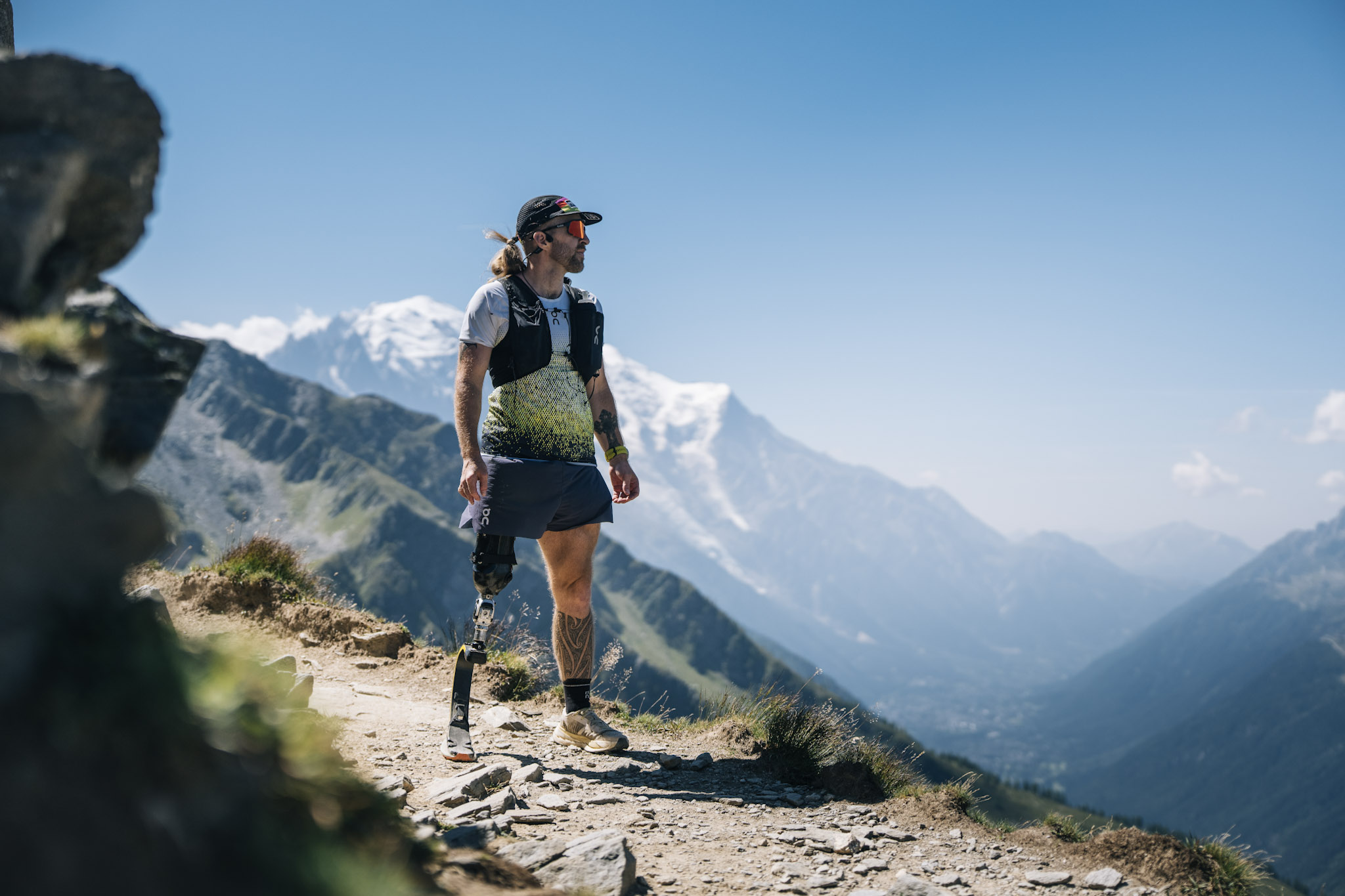
It was August 2022, and the American trail runner was inching his way through the Swiss Alps, attempting to become the first known adaptive athlete to complete a race at the Ultra-Trail du Mont-Blanc®—arguably the most prestigious series of trail races in the world. The mountains rose like walls. The trails were steep, rutted, and slick with rain. And with every step, Zach slid backward.
“Coming here in 2022 and looking at the mountains, I was immediately like, ‘Oh shit. I’ve never seen anything like this,’” he said. “And the race was just a complete disaster.”
UTMB had no adaptive category at the time. No guide program. No established protocol for an athlete missing a limb. Zach, who gained entry into the field through a sponsor connection, was largely on his own. The course—Martigny-Combe to Chamonix, known as the MCC—was a notorious 40km (25 mile) technical trail race. That year, relentless rain turned grass into grease and singletrack into mud chutes.
At the time, Zach’s running blade was outfitted with what amounted to a road-shoe outsole—minimal tread, no bite. “It was worse than running in sand,” said Zach. He was 30 minutes past the cutoff at the first checkpoint. Without much discussion, the aid station crew cut his bib off and ushered him off the course. He was done.
“They maybe didn’t even want me there, to be honest,” Zach said. “But I kind of knew going in that somebody had to get out there and take the blows in the face. Somebody had to do it first.”
Neither side was prepared, it seemed. Zach had never raced in Europe. The Alps were bigger than anything he’d encountered in the U.S. The trails were steeper, more technical, and less forgiving. And his prosthetic simply wasn’t built for the demands of the terrain.
Still, he came back.
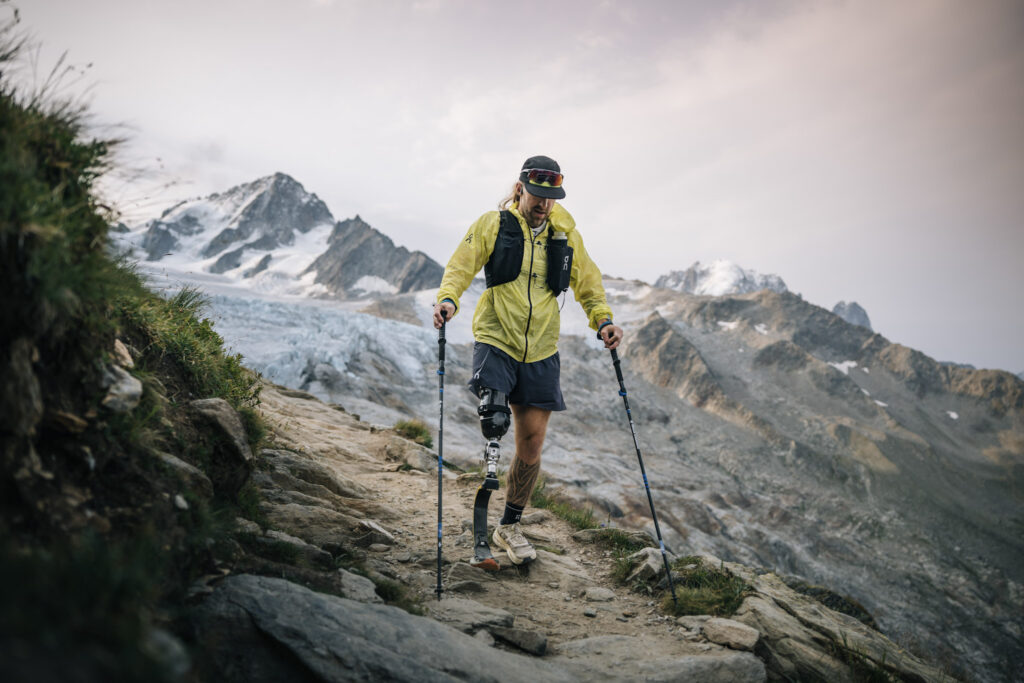
The following year, Zach returned to UTMB with a guide and assurances from the race that he’d have a wider margin of error to finish the course. Officials knew he was there but word was never disseminated to race staff on the ground. When he arrived in Argentière five minutes past the cutoff, the aid station team again tried to cut his bib number off, even though he’d been approved to have more time. But Zach didn’t let them.
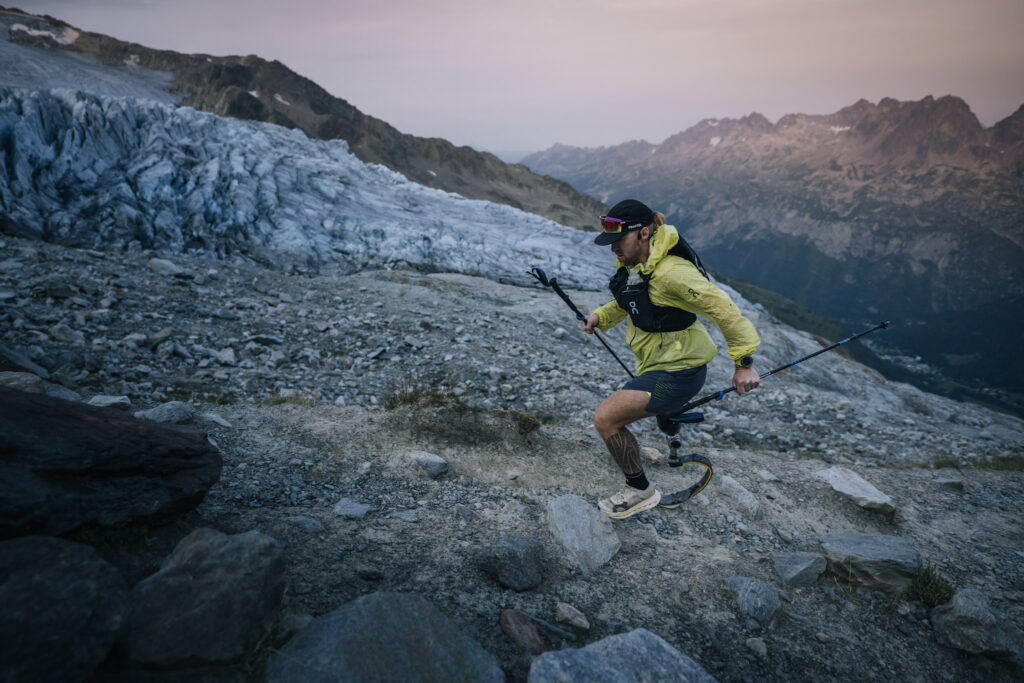
Up ahead of him on the course, the staff were taking down trail markings, not realizing he was going to finish no matter what. He took wrong turns. He got lost. But Zach was determined. He made it to the finish line past the cutoff time in what he now calls his “rogue finish,” becoming the only known blade runner to complete a UTMB event.
Regardless, the conversations had begun. “There’s been progress,” he said. “That didn’t exist before.”
For Zach, visibility is the point.
“You can’t be what you can’t see,” he said. “That goes for everybody. Representation isn’t just for disabled people—it raises the consciousness for everyone else.”
Zach was born without his right leg from above the knee and missing fingers on his right hand. He grew up in Kansas with wrestling as the family sport—hard, demanding, and nonnegotiable. His father taught him important lessons on the mats. There would be no room for self-pity. Zach would simply have to work harder than everyone else, focusing on small, daily improvements.
“We broke everything down into tangible goals I could actually reach,” Zach said. “My dad would say, ‘Hey, you’re getting your ass whooped—but let’s focus on not getting pinned this year.’ I’d lose 15–0, come off the mat, and high-five him because I didn’t get pinned. The next year it was, ‘Don’t get pinned and maybe keep the score under 10.’ Then, ‘Let’s score a point,’ then ‘Maybe win a match.’ And that’s what happened.”
He paused. “You stack those little building blocks and start climbing the ranks. One day, I was the one handing out the ass whoopings. I had to build my own stairs.”
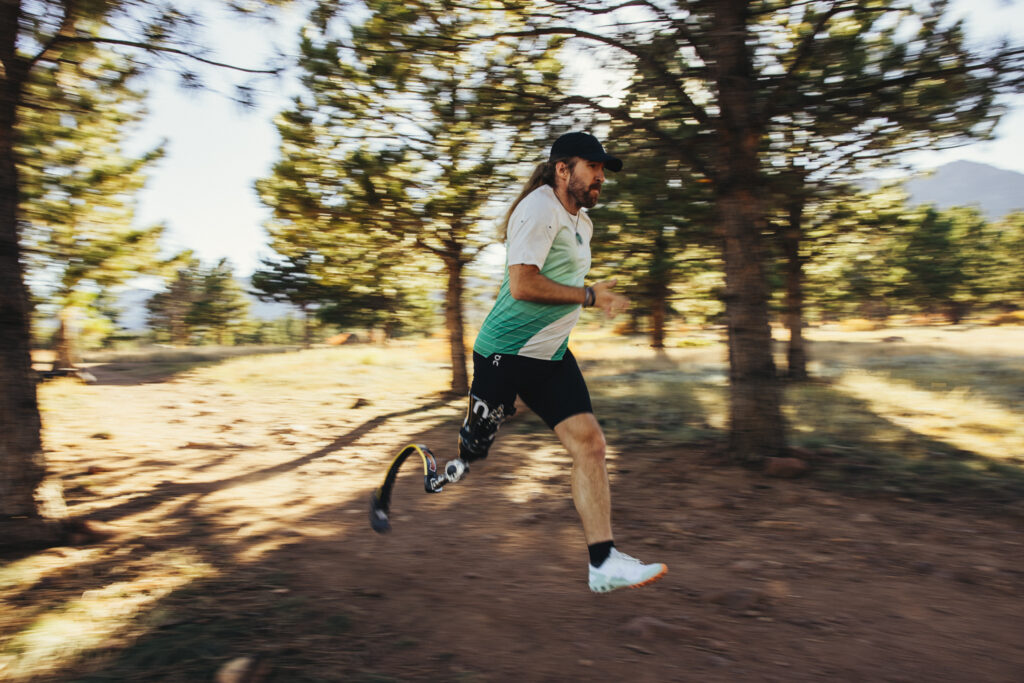
On a whim In 2019, Zach traveled to the Born to Run Festival in Los Olivos, California with a friend. He approached the race director, Luis Escobar, and asked if it would be okay for him to race the 10-miler. “I’m okay if you’re okay,” Luis told him.
The race was a transformational experience for Zach.
It was the furthest he’d ever run. “The entire experience blew my mind,’ said Zach, “and by the end of that race, I was not only hooked on running, but I wanted to do something to make sure that other people like me knew they too could experience the same feelings of freedom, elation, joy, and oneness with the outdoors.”
The following year he would go even further. “He signed up for one of our most challenging 50km courses in Quincy, California—technical and steep,” said Luis. “There are sections with no trail at all. It’s just dead reckoning up the side of a real mountain.”
Luis was stationed at the top of one particularly brutal climb when he saw Zach approaching. “The guy is literally on his hands and knees, crawling. I felt bad—like, this is too much. Then he sits down, grabs a stick, and starts banging his artificial knee to get the rocks out of it.”
“That’s the kind of person I want to be around,” said Luis. “But honestly, the Zachary Friedley story isn’t really about Zachary Friedley or what he’s done, it’s about how he’s impacted the people around him.”
In 2019, with Luis as his first advisor, Zach started the non-profit Born to Adapt, and began facilitating adaptive trail events around the globe. Their mandate was simple: increase societal awareness around disabilities and foster spaces where everyone can have access to the transformative power of movement, community, and the great outdoors.
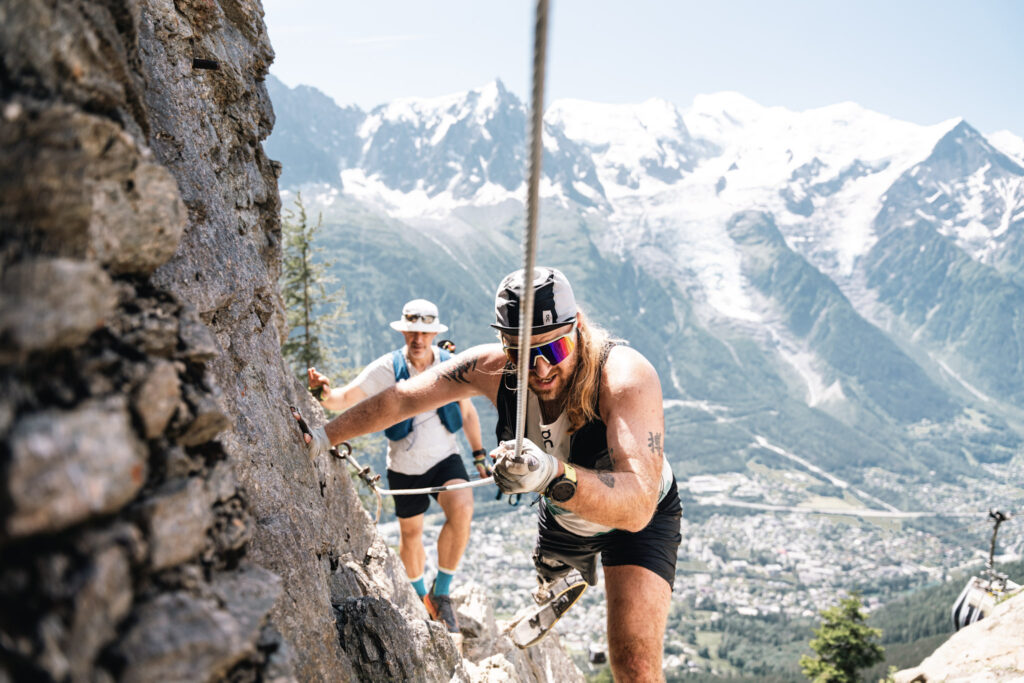
After his disappointment at UTMB, Zach set his sights on a different kind of challenge. In October of 2022, he headed to Ecuador to climb one of the world’s highest active volcanoes, Cotopaxi Peak, the country’s second-highest mountain at 5897 meters (19,347 feet).
While training with a large, diverse, and bilingual group on nearby Rumiñahui Peak, he handed his backpack to one of the guides and asked a simple question: could he run down?
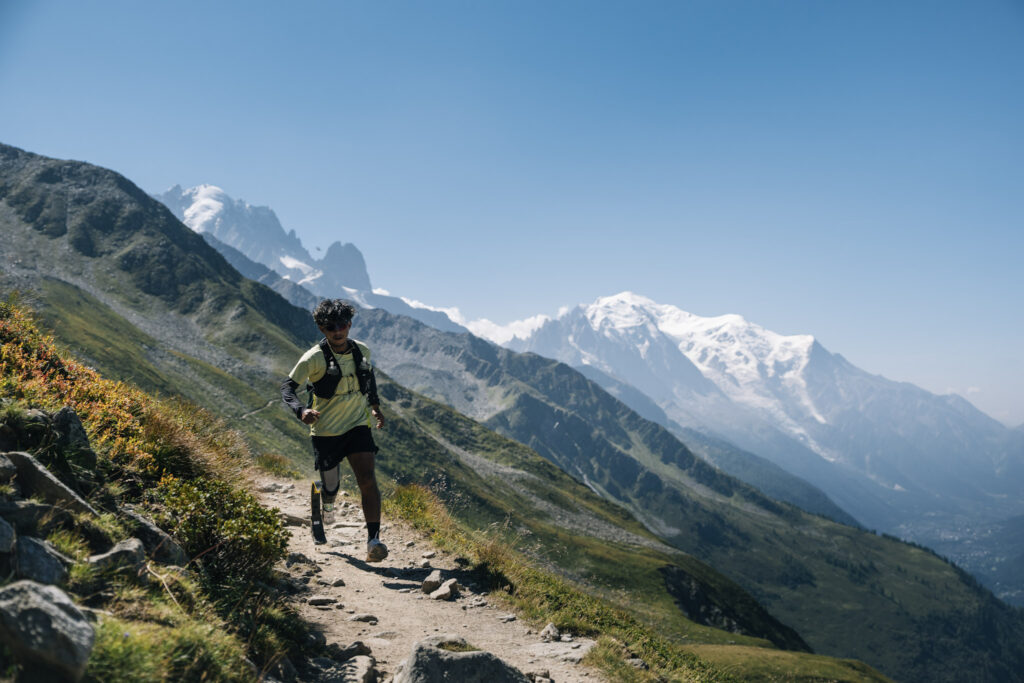
While descending, a motion flickered in his peripheral vision. Another athlete—also running on a blade—came flying past him on the trail before peeling off. The runner was Jahir Ramos, an Ecuadorian below-the-knee amputee. “That was the first time I ever ran with anyone in the mountains who was also missing a leg,” said Zach.
Later that day, Jahir’s translator approached Zach. “Jahir wants to learn to run like you,” he said.
With the help of Google Translate, their friendship deepened. Jahir visited California, where they ran trails and talked tech about running blades. Soon Zach was coaching Jahir, who also dreamed of racing Europe’s biggest trail-running events. So Zach began lobbying to get Jahir into France for the OCC, a 56-kilometer (35-mile) UTMB trail race with 3460 meters (11,350 feet) of climbing.
Getting Jahir a French visa proved more difficult than the race itself. The 20-year-old was denied multiple times. Zach pleaded with officials, wrote letters, had Jahir endorsed by UTMB and Run the Alps. And when all that failed, he took the fight online, imploring his followers for help.
“Sport is powerful and this was one of these moments,” Zach wrote in a post declaring that Jahir had been cleared at the last minute to enter France in time to fulfill his dream of racing in the European Alps.
On August 28, 2025, Jahir completed the rough course through the Alps with more than 11,000 feet of climbing… in a rain storm.
He was the only bladerunner on the course.
More about Zach and Born to Adapt
We Belong
2025 Run the Alps Short Film Grant Winner, funded by On and Tailwind
Created by Milo Zanecchia | Featuring Jahir Ramos, Zach Friedley, Dani Aravich and Fabrice Perrin
The short film, We Belong, examines the current state of adaptive athlete participation in trail running, as the sport begins to reckon with who it truly makes space for. Participation is increasing, driven by advocates and athletes such as Zach Friedley and Dani Aravich of Born to Adapt, and major races like the UTMB are taking meaningful steps toward inclusion. Still, important work remains.
The film follows adaptive athlete Jahir Ramos as he prepares to compete in the UTMB OCC in 2025. It uses his journey to highlight both the progress being made and the work still to be done. It aims to encourage broader engagement across the trail running community, with the objective of advancing a more inclusive future for the sport.
Born to Adapt: Driving Inclusion in Trail Running
From policy to practice. From access to action.
Born to Adapt works at the intersection of Para Athletes, race organizers, tour operators and other global partners to implement inclusion practices that work in real life —not just on paper.
Get more info about trail running events and resources where Born to Adapt–aligned inclusion is already happening.
On Running Sierre-Zinal: An Interview with Zach Friedley
Read an interview with Zach after running Switzerland’s legendary Sierre-Zinal.
Matt Hart is a journalist and editor whose work has appeared in The New Yorker, The Atlantic, The New York Times, National Geographic, and Outside magazine, among others. His reporting has been selected for The Best American Sports Writing and optioned for film and television. He is the author of the 2020 book Win at All Costs. A longtime ultrarunner and ski mountaineer, Matt has called the Cascades, Wasatch, Front Range, and White Mountains home over the years.